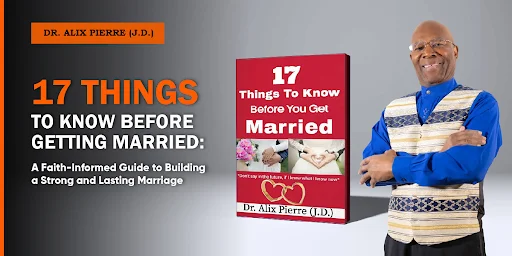
Things to Know Before Getting Married: A Christian Guide (17 Things I Tell Every Couple)
The single most important thing to know before getting married is that chemistry tells you almost nothing about whether a marriage will last, while character, conflict style, and shared faith conviction tell you almost everything. I’ve sat across the table from enough engaged couples to know that the ones who ask hard questions before the wedding are the ones who don’t need a counselor for crisis intervention five years into it.
I’m Dr. Alix Pierre, J.D., and I come at marriage prep from two directions most people don’t combine. I’ve read the legal paperwork that shows up when a marriage ends the filings, the disputes, the things nobody saw coming. And I’ve sat in premarital counseling rooms with couples who are three months from a wedding, asking questions they should have asked a year ago. This guide is everything I wish every couple heard before they set a date, not after.
Who This Guide Is For
If you’re engaged, seriously dating, or even just wondering whether you’re the “marrying kind” yet, this is written for you. I’m not going to give you a fluffy list of feel-good tips. I’m going to give you the real, sometimes uncomfortable questions I ask in my own counseling sessions, along with what the Bible actually says about choosing and becoming a good spouse.
What Are the Most Important Things to Know Before Getting Married?
The most important things to know before getting married are how your partner handles conflict, what your shared faith actually looks like in daily practice, how you each handle money, and whether you’re choosing each other from wholeness or from fear of being alone.
I ask every couple I counsel the same opening question: “Tell me about the last real fight you had.” Not the small stuff, the real one. How they answer tells me more in five minutes than most dating apps tell you in five months. Couples who can describe a disagreement, how they repaired it, and what they learned are couples who’ve already built the muscle marriage requires. Couples who can’t remember a real conflict yet are couples who haven’t been tested.
The Four Pillars I Look For
- Conflict repair — not whether you fight, but whether you know how to come back together after
- Faith in practice — not “we’re both Christian,” but whether you pray together, attend church together, and handle moral disagreements the same way
- Financial alignment — spending habits, debt, and giving philosophy, discussed specifically, not vaguely
- Motivation for marrying — choosing this person because of who they are, not because you’re tired of being single
The most important pre-marriage knowledge centers on four pillars: how a couple repairs conflict, how faith is actually practiced day to day, whether financial habits align, and whether the decision to marry comes from genuine choice rather than loneliness or pressure. A couple’s ability to describe and recover from a real disagreement is one of the clearest early signals of marriage readiness.
What Questions Should You Ask Before Marriage?
You should ask questions that reveal values and habits rather than questions with easy, expected answers. The goal is to surface disagreement now, while it’s cheap, rather than after the wedding, when it’s expensive.
I give my clients a rule: if a question can be answered in one word, ask a follow-up. “Do you want kids?” gets a yes or no. “How many kids, when, and what happens if we can’t agree on timing?” gets you the real conversation.
Questions to Ask Before Marriage, By Category
|
Category |
Question to Ask |
Why It Matters |
|
Faith |
How do we want to practice our faith daily, not just on Sundays? |
Faith mismatch surfaces in every other disagreement over time |
|
Finances |
Will we combine our accounts, and who manages the budget? |
Money is consistently one of the top predictors of marital conflict |
|
Family |
How many kids do we want, and by when? |
Vague agreement now becomes real conflict later |
|
Career |
Whose career takes priority if we have to choose? |
Avoids resentment when a hard choice actually comes up |
|
Conflict |
When we disagree, do you need space, or do you need to talk immediately? |
Mismatched conflict styles cause more damage than the disagreement itself |
|
In-laws |
How involved should our parents be in our major decisions? |
Boundaries set early prevent years of quiet resentment |
|
Past relationships |
Is there anything from your past you haven’t fully processed? |
Unprocessed history tends to surface at the worst moments |
I tell couples to write their answers separately, on paper, before comparing them out loud. It removes the instinct to give the “nice” answer instead of the honest one.
Effective premarital questions target specifics, not generalities, timelines for children, exact financial arrangements, conflict-repair habits, and boundaries with extended family. Writing answers separately before discussing them out loud produces more honest, less performative responses than talking it through live.
How Do You Choose a Wife or Husband the Right Way?
You choose a wife or husband the right way by watching characters under pressure over time, rather than trusting how someone makes you feel in comfortable moments, and by involving people who know you well enough to tell you the truth.
I’ve watched this go wrong the same way more times than I can count: someone falls for how a relationship feels early on and stops gathering information. Feelings are data, but they’re incomplete data. The character of how someone treats people who can’t do anything for them, how they respond when corrected, how they handle stress is the data that actually predicts the next thirty years.
What to Watch For When Choosing a Spouse
- How they treat waitstaff, service workers, and people with no power over them
- How they respond when you tell them “no” or disagree with them
- Whether they take responsibility when wrong, or explain it away
- Whether their friendships have lasted, or whether people tend to fall out of their life
- Whether your closest, most honest friends and family have real concerns and whether you’ve actually asked them
- Whether they are growing spiritually or drifting, and in which direction that trend is heading
Proverbs offer a striking amount of practical wisdom here. Proverbs 31:30 puts the emphasis on “the fear of the Lord” over beauty as the trait that actually endures, and Proverbs 14:1 warns that a wise or foolish spouse literally builds or tears down a household over time this isn’t abstract poetry, it’s a pattern I’ve watched play out in real marriages.
Choosing the right spouse means prioritizing observable character over emotional comfort, how someone treats powerless people, handles correction, and takes responsibility. Proverbs consistently points to reverence for God and practical wisdom as the traits that predict a lasting marriage more reliably than attraction alone.
What Are the Qualities of a Good Wife or Husband?
The qualities of a good wife or husband, according to both Scripture and what I’ve seen hold marriages together in practice, are faithfulness, humility, respect, active love, and consistent spiritual growth not perfection, but a demonstrated pattern of choosing the relationship even when it’s inconvenient.
Ephesians 5:25 and 5:33 outline this from both sides: husbands are called to love their wives sacrificially, wives are called to respect their husbands, and I’ve found that couples who actually live this out, not just quote it, build something durable. 1 Corinthians 13:4-7 gives the clearest working definition of love I know of: patient, kind, not self-seeking, not easily angered and I use it as a practical checklist, not just a wedding reading.
Qualities of a Good Wife
|
Quality |
What It Looks Like in Practice |
Reference |
|
Reverence for God |
Faith shapes daily decisions, not just Sunday attendance |
Proverbs 31:30 |
|
Wisdom and discretion |
Handles conflict and decisions with good judgment |
Proverbs 14:1, 11:22 |
|
Diligence |
Actively contributes to the household’s wellbeing |
Proverbs 31:16-17 |
|
Trustworthiness |
Partner feels safe being vulnerable and transparent with her |
Proverbs 31:11-12 |
Qualities of a Good Husband
|
Quality |
What It Looks Like in Practice |
Reference |
|
Sacrificial love |
Puts the relationship’s wellbeing above his own convenience |
Ephesians 5:25 |
|
Provision and leadership |
Takes responsibility for the family’s material and spiritual needs |
1 Timothy 5:8 |
|
Faithfulness |
Committed emotionally and physically, without exception |
Hebrews 13:4 |
|
Honest communication |
Creates a safe space for his wife to speak without fear |
Proverbs 15:22 |
Neither list is a scorecard for judging a partner from a distance. It’s a lens for watching how someone actually behaves over months, not what they say they believe in a single conversation.
Biblically grounded qualities of a good wife include reverence for God, wisdom, diligence, and trustworthiness (Proverbs 31), while qualities of a good husband include sacrificial love, provision, faithfulness, and honest communication (Ephesians 5, 1 Timothy 5). These are behavioral patterns to observe over time, not traits to take on faith from a single conversation.
What Are the Signs That a Relationship Is Broken?
A relationship is broken when trust has been repeatedly violated without real repair, when contempt has replaced ordinary conflict, or when one or both partners have quietly stopped fighting for the relationship and started merely coexisting in it.
I draw a hard line between “hard” and “broken” in every counseling session, because confusing the two causes real damage in both directions. Good couples give up during a hard season, and struggling couples marry through something that was actually broken.
|
Sign |
What It Looks Like |
Hard Season or Broken? |
|
Frequent disagreements |
Conflicts that get resolved, even if imperfectly |
Usually hard |
|
Contempt |
Eye-rolling, mocking, or name-calling as a recurring pattern |
Broken |
|
Stonewalling |
One partner consistently shuts down and disengages |
Broken |
|
Temporary financial stress |
Tension tied to a specific, resolvable situation |
Usually hard |
|
Repeated betrayal |
Trust broken more than once with no real repair process |
Broken |
|
Seasonal distance |
Less time together due to a busy season, not disinterest |
Usually hard |
|
Any form of abuse |
Physical, verbal, emotional, or financial control |
Broken prioritize safety and professional support |
If what you’re recognizing is in the “broken” column, that’s not a marriage-timeline conversation anymore, it’s a safety and counseling conversation that needs to happen before any wedding date does.
A relationship is broken, not just difficult, when contempt, stonewalling, repeated betrayal, or abuse becomes the recurring pattern rather than an exception. Temporary financial stress or seasonal distance is usually survivable; contempt and abuse are signals to seek professional help before continuing toward marriage.
What Should You Discuss Before Getting Married?
You should discuss finances, faith practice, children, in-law boundaries, conflict style, and career expectations in specific, concrete terms before getting married. Vague agreement on these topics is one of the most common reasons couples end up blindsided later.
Every one of these conversations feels a little awkward the first time, and that discomfort is usually the sign you’re finally past the surface-level version of the conversation.
Marriage Expectations Worth Naming Out Loud
- How household responsibilities will be divided, and whether that matches what you each grew up watching
- What “quality time” actually means to each of you, in hours and activities, not just the phrase
- How holidays and extended family time will be split
- What financial transparency looks like shared visibility into every account, or something less
- How you’ll handle a major disagreement neither of you saw coming
I’ve watched more marriages strain over unspoken expectations than over any single dramatic event. The couples who write these down and revisit them yearly tend to weather changes far better than the couples who assumed they were already aligned.
Premarital conversations should move past general agreement into specific expectations of how chores are divided, what quality time actually looks like, financial transparency, and holiday planning. Naming expectations explicitly, rather than assuming alignment, prevents a large share of the resentment that builds in the first years of marriage.
Is Financial Compatibility Something You Can Fix Later?
Financial compatibility is much easier to build before the wedding than after it, because once joint accounts, shared debt, and daily financial habits are already in motion, disagreements carry real consequences instead of just being hypothetical.
I’ve reviewed enough post-divorce financial disputes to say this plainly: very few marriages fall apart because of a single financial disaster. Most erode slowly, from a spender and a saver never building a shared system, or from one partner hiding debt, or from one partner feeling financially controlled.
Financial Questions Every Couple Should Answer
- What debt is each of you bringing into the marriage, and what’s the payoff plan?
- Are you a spender or a saver, and how will you build a budget that respects both tendencies?
- Will one of you step back from work for children, and how does that affect the household budget?
- What’s your approach to giving and tithing as a couple?
- Should you consider a premarital agreement, especially if either of you owns significant assets already?
A premarital agreement isn’t a sign of distrust for couples with existing assets, prior obligations, or business interests, it’s a clear, biblically defensible act of stewardship that removes ambiguity rather than creating suspicion.
Financial compatibility is far easier to establish before marriage than to repair after it, since shared accounts and debt raise the stakes of any unresolved habits. Most financial strain in marriage traces back to mismatched spending styles, hidden debt, or a lack of shared financial visibility all of which are addressable through direct, specific pre-wedding conversations.
How Do You Know If You’re Emotionally Mature Enough to Marry?
You know you’re emotionally mature enough to marry when you can sit with disappointment without needing to fix it immediately, when you can take responsibility for your part of a conflict without deflecting, and when you’re choosing this relationship from a place of wholeness rather than to escape loneliness.
I test this directly with a question I ask nearly every client preparing for marriage: “What’s the last thing you apologized for, and did you mean it?” People who can answer specifically, without minimizing, tend to have done real internal work. People who can’t remember a recent, sincere apology usually haven’t yet.
Signs of Emotional Maturity Worth Noting in a Partner
- They can discuss a past mistake without blaming everyone else involved
- They regulate their emotions under stress instead of escalating every disagreement
- They can hear “no” or criticism without becoming defensive or withdrawing
- They’ve done some form of self-reflection therapy, mentorship, or serious spiritual counsel at some point in adulthood
Emotional maturity before marriage shows up as the capacity to sit with disappointment, take ownership of conflict without deflecting, and choose a partner from genuine desire rather than fear of being alone. A person’s ability to give a specific, sincere apology is a simple but reliable indicator of this maturity.
What About Sexual Compatibility Before Marriage?
Sexual compatibility before marriage, for couples committed to a Christian standard of waiting, is less about physical experience and far more about honest conversation regarding expectations, past experiences, and any unresolved shame or trauma either partner carries into the marriage.
This is a topic a lot of Christian premarital content either skips or handles in vague spiritual language, and I don’t think that serves couples well. Avoiding the conversation before the wedding doesn’t make the wedding night easier; unspoken expectations tend to surface exactly when connection matters most.
What Worth Discussing With a Counselor Before the Wedding
- Any past trauma or difficult experiences your partner needs to understand
- Expectations around intimacy and how you’ll talk through mismatches without shame
- Any physical or health considerations that could affect intimacy
- How you’ll approach this conversation together as an ongoing part of the marriage, not a one-time talk
Sexual compatibility before marriage centers on honest, specific conversation about expectations and any unresolved trauma, not prior physical experience. Christian couples benefit from working through this with a premarital counselor ahead of the wedding rather than leaving it unaddressed until the honeymoon.
The 17 Things to Know Before Getting Married: My Christian Checklist
Here’s the practical, step-by-step checklist I walk every couple through in counseling. Work through it in order don’t skip a step because it feels uncomfortable, because the uncomfortable ones are usually the ones that matter most.
- Clarify your shared faith practice — not just “we’re both Christian,” but what that looks like daily.
- Have the finance conversation on paper, separately, then compare.
- Identify your and your partner’s conflict repair style.
- Ask the specific children question — number, timing, and what happens if you disagree.
- Set in-law and extended-family boundaries before the wedding, not after.
- Watch characters under pressure, not just chemistry in comfort.
- Get honest input from people who knew you before this relationship started.
- Evaluate qualities of a good wife or husband against real behavior, not just words.
- Assess whether the relationship is hard or genuinely broken, using the signs above.
- Discuss career priorities and what happens if you have to choose between them.
- Name your expectations around chores, time, and holidays explicitly.
- Have the sexual expectations and a history conversation with a counselor.
- Consider a premarital agreement if either of you has significant assets or prior obligations.
- Test emotional maturity — can you both apologize sincerely and take ownership?
- Complete formal premarital counseling, Christian, licensed, or both.
- Set shared decision-making roles for major life choices.
- Set a realistic timeline for the engagement — rushing rarely produces a stronger marriage.
This 17-point checklist moves from faith and financial alignment through conflict style, family boundaries, and character evaluation, into emotional maturity and formal counseling, ending with a realistic engagement timeline. Each step is designed to surface disagreement before the wedding, when it’s far less costly to address.
My Christian Marriage Advice Before You Set a Date
If I had to condense everything above into one piece of Christian marriage advice, it’s this: don’t let the excitement of being chosen rush you past the work that determines whether the marriage actually lasts.
I’ve counseled couples who did nearly everything right on paper and still hit rough patches, because they treated the wedding as the finish line instead of the engagement season as genuine preparation. Formal premarital counseling, done seriously over several months rather than a single weekend retreat, consistently catches the misalignments a few months of dating simply won’t reveal. read more Christian marriage guidance. If you’re in this season right now, that’s the concrete next step. I’d point you toward not another article, but an actual conversation with a counselor who will ask you the hard questions.
Final Word
Things to know before getting married is a genuinely researchable question, and I’ve tried to give you the direct, specific version of the answer rather than a list of feel-good platitudes. Christian marriage advice works best when it’s paired with real, concrete conversations about faith, money, conflict, and character, not just good intentions. Work through the checklist above with your partner, and if something in it makes you uncomfortable, that’s usually the exact place worth slowing down to examine more closely before you set a date.
Frequently Asked Questions
What is the most important thing to know before getting married?
The most important thing to know before getting married is how your partner handles conflict and disappointment, because that pattern shows up in every season of a marriage, not just the hard ones. I ask this in nearly every session I run: couples who can describe a real disagreement and how they repaired it are almost always better prepared than couples who’ve never truly been tested yet.
How do I know if I'm choosing the right spouse?
You’re likely to choose the right spouse if their character holds up under pressure, if trusted people in your life affirm the relationship, and if the decision feels like genuine choice rather than relief from loneliness. I’ve watched clients confuse comfort with rightness before — comfort fades in and out throughout a marriage, but demonstrated character, watched over time, doesn’t.
What are the biblical qualities of a good wife or husband?
Biblically, a good wife is marked by reverence for God, wisdom, and diligence (Proverbs 31), while a good husband is marked by sacrificial love, provision, and faithfulness (Ephesians 5, 1 Timothy 5). In practice, I look for these as consistent behaviors over months, not statements made once in a single conversation. That’s the difference between a value someone holds and a value someone performs.
What financial questions should couples discuss before marriage?
Couples should discuss existing debt, spending versus saving tendencies, giving and tithing philosophy, and whether a premarital agreement makes sense given either partner’s assets. I’ve seen enough financial disputes surface after the wedding to know that vague agreement “we’ll figure it out” is rarely actually agreement at all.
How can I tell if my relationship is healthy enough to marry?
A relationship is healthy enough to marry when disagreements get resolved rather than repeated, when trust hasn’t been broken without real repair, and when contempt isn’t part of how you communicate. If you’re seeing contempt, stonewalling, or any form of abuse instead, that’s a signal to pause and seek professional support before moving toward marriage, not a pattern to marry through.
Is premarital counseling actually necessary for Christian couples?
Yes, in my experience, formal premarital counseling consistently surfaces disagreements that months of dating alone won’t reveal, because a trained counselor asks the specific, uncomfortable questions couples tend to avoid asking each other. I’ve seen it change wedding timelines more than once, and every time, the couple was better for having paused.